I enjoyed this:
Showing posts with label ubicomp. Show all posts
Showing posts with label ubicomp. Show all posts
Thursday, July 17, 2008


Monday, January 21, 2008
Novel on life-streaming
Duncan Riley at Tech Crunch has posted a blog entry on life-streaming and privacy where he argues that some areas of one’s life should remain private, that is, unstreamed.
What I found most interesting about Riley’s post was his reference to a new novel by Ben Elton called Blind Faith, which deals with the topic of privacy and surveillance in the age of ubiquitous computing. Here’s part of the novel’s description from Amazon, which Riley posted with his blog entry:
Imagine a world where everyone knows everything about everybody. Where what a person “feels” and “truly believes” is protected under the law, while what is rational, even provable is condemned as heresy. A world where to question ignorance and intolerance is to commit a Crime against Faith.
...
Ben Elton imagines a post-apocalyptic society where religious intolerance combines with a confessional sex-obsessed, self-centric culture to create a world where nakedness is modesty, ignorance is wisdom and privacy is a dangerous perversion. A chilling vision of what’s to come? Or something rather closer to what we call reality?
It sounds like a good read. Maybe I’ll have time to get to it when it comes out this summer.
Wednesday, January 16, 2008
Review: Adam Greenfield, Everyware: The Dawning Age of Ubiquitous Computing (2006)


One unique feature of this book is Greenfield’s reaction to ubiquitous technology. It seems like the typical reaction to new technology (see genetic modification and nanotechnology) is to question the ethics of using/adopting it and to call for a halt to this use/adoption so its long-term effects can be contemplated. Greenfield, however, simply declares that everyware is inevitable, and that our best efforts will be spent in working toward altering its eventual appearance, rather than trying to prevent it.
In Section 3, “What’s driving the emergence of everyware?”, Greenfield examines the reasons for this inevitability. His argument is essentially twofold: first, he claism that at the moment our technology became digital, and devices were able to communicate with each other in a common language of ones and zeros, that the communication and interoperability on which everyware depends was a foregone conclusion. Further, Greenfield argues that the architecture and capabilities of many current technologies—RFID tags, the continuing development of computer chips, wireless computing—all contain the latent possibility of everyware. As he puts it, a technology like RFID “wants” to be connected to everything so as to provide a bridge between atoms and bits. Second, he argues that everyware is inevitable because it is both embedded in our collective imaginations in the form of science fiction and a workable solution to many of our looming problems, such as dealing with the move of the baby-boom generation into old age and the need of corporations for ever-increasing economic expansion.
Another thing I liked about the book is that Greenfield captures the complexity and contradictions inherent in ubiquitous systems. Everyware is divided into seven sections, and each section is made up of “theses” introduced by short, declarative statements (“Thesis 05: At its most refined, everyware can be understood as information processing dissolving into behavior.”), which are then explained, expanded on, or defended over the course of a few pages. While the sections gather the theses into larger arguments, I think they allow Greenfield to not force an extreme level of coherence on a topic whose edges are still coming into view.
To me, the two most interesting sections of the book are the first two (Google Books has the complete TOC). In these sections, Greenfield defines everyware and explains how it is unique from other instantiations of computing. As I noted above, he argues that everyware is not the same as ubicomp, but is rather a paradigm which contains many ubicomps. According to Greenfield, the everyware paradigm is the interconnection of various technologies and processes so that the computing experience will no longer be centered on a desktop or laptop machine, but will be a continuous experience of information retrieval (and encoding) via technology embedded in our surroundings. As part of this process, the bridging of the divide between data and the lived world will be key to the development of everyware.
One of his most striking pronouncements is that everyware will transform behavior into information, or, as he puts it, everyware represents the “colonization of everyday life by information technology.” Greenfield recognizes the emergent qualities of the combination of ubiquitous computing and society. Everyware is different from regular computing in that it is centered on the user and the environment. It is contextual and experiential, rather than a group of tasks like information retrieval. It does not have users—although it might have subjects. It is relational, and, as such, it has the possibility of yoking together a number of technologies and systems that we are already familiar with so that they become greater than the sum of their parts. Further, these connections will result in outcomes and effects that will be completely unforeseen.
In the book’s second section, Greenfield describes how everyware is unique. According to Greenfield, the combination of ubiquitous technologies on which everyware is based, fostered by digital connections and their inherent relational structures, will lead to emergent outcomes. That is, it will not be possible to completely foresee the results of this technology interacting together, and this fact virtually guarantees that the result will be unique. (Which would make pausing the development of the technologies everyware depends on so we can contemplate their use virtually pointless.)
Conclusion: Everyware is a good, non-technical introduction to the issues affecting the development of ubiquitous computing. I think it would be a good text for introducing undergrads to the opportunities and problems associated with new, distributed computing models.
Sunday, December 16, 2007
Advertising panopticon
I saw two new interesting developments that will enable directed advertising in the next year.![Xuuk]s eye-tracking device](https://blogger.googleusercontent.com/img/b/R29vZ2xl/AVvXsEjE_mu3BScGRmf9XEKlpXELJUElQv25OXobvL_RTz6S4AFpHVJzZvAM_cPfix6KjurpQvp619tW8Nu78XrweB99U_u390rG8MKiAKfXuxlqaH0XK7hzZWveT5a3pau8S_ersGpE/s1600/eye_tracker.jpg) • Xuuk’s eye-tracking technology. The devices use
• Xuuk’s eye-tracking technology. The devices use
infrared sensors to look for the red-eye phenomenon familiar from family snapshots. The device looks like a small webcam and can detect a passing glance from over 30 feet away. This year, the company will roll out its Eyeanalytics software, letting advertisers monitor how many people are looking at each of their ads, and for how long.
As the internet-advertising model becomes more dominant, this kind of technology is going to become more in demand.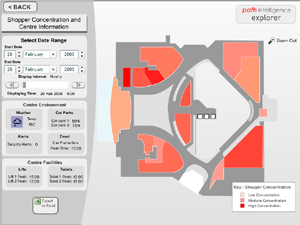 • Path Intelligence’s foot-traffic tracking. According to TechCrunch
Path Intelligence is a U.K. based company that monitors foot traffic in a rather ingenious way, through customers’ cell phones. Periodically our cell phones ping the nearby cell towers basically saying “Here I am”. Path Intelligence has built receivers that detect these signals and triangulate the owner’s location with accuracy of up to a meter.
Each ping also includes the cell’s unique identifier (think IP address). While these IDs help track the movement of the signal and it’s owner, they don’t reveal the identity of the user. Only your service provider knows that. This is a similar, but more precise method than Google Maps is using to detect your general location on your mobile phone by cell tower.
While it is encouraging that it the unique identifiers are not available to the service, I don’t think this anonymity will be worth much. Unless there are laws in place that state otherwise, just like ISPs turn over IP addresses whenever they are asked for, these identifiers will be available whenever law-enforcement demands them.
Wednesday, December 12, 2007
Ubiquitous audio: “a heads-up display for your ears”
In a recent article, Peter Drescher argues that stereo cellphone headsets will make possible interactive communication experiences on the go.
I’m looking at wireless stereo headsets, and thinking that as they become more comfortable, more useful, more powerful, more commonplace, and more stylish, there will be fewer and fewer reasons to ever take them off. Eventually, you’ll just stick them in your ears and forget about ‘em. They will become like acoustic contact lenses, or a heads-up display for your ears. They’ll let you access and control a virtual audio reality that streams in from wireless networks all around you and is mixed with voice data from your phone and from everybody’s phone. And although the ubiquitous audio network I’m describing does not yet exist, you can actually listen to what it might sound like today.
It’s completely analogous to being in a recording studio, isolated by big headphones, auditioning multiple tracks, and talking to the control room via live mic. I remember my first time in a real studio: I put on the cans and was astounded by the sense of space, the detailed audio field, and the sound of my own voice—in my head, through the mixing board. Now imagine that feeling as a mobile experience, but instead of talking to the engineer on the other side of the glass, you’re walking down Broadway, talking to someone on the other side of the world.
In response, Tim O’Reilly points out that stereo headsets will be the first components of mainstream wearable computing.
I’m sure that at first, when only a few people are living in the mobile “heads up” auditory network, they will be quite “annoying” in public spaces, but eventually, I imagine we'll figure out how to deal with that. There's a lot that's compelling in this vision. I've always imagined heads-up visual displays being one of the harbingers of the era of wearable computing, but Peter makes a pretty compelling case that it’s in audio that we’re going to see the first signs of ubiquitous wearable computing.
“God” box
Jon Oltsik at the CNET News Blog posted a blog entry this week on the “god box,” a single device “packed with ridiculous amounts of functionality.”
Think of an all-in-one television, cable box, TiVo, and home entertainment speaker system and you get the idea. One “god box” always replaces numerous more pedestrian systems.
According to Oltsik, new developments in processors, hardware commodification, and software are going to make these god boxes a reality.
My problem with this idea, though, is that I’m not sure who would want this kind of functionality in a single box. One caveat: though he doesn’t come out and say this, I think Oltsik’s post might be directed at the business networking crowd. I can see why a business IT department might want to distribute god boxes as terminals. However, since he brought up the home entertainment example, I don’t see how a god box would be desirable in that context. I think consumers have made it clear that they don’t want certain kinds of hybrid devices: computers that connect to the television have never caught on, for example. Rather, what people want is ease of connectivity, a “god network,” if you will. They want to watch TV on their TVs and compute on their computers; but, when they are away from those devices, they want to access their music, documents, TiVo programs, or live TV on their MP3 players or phones.
I think it is far more likely that the technological innovations Oltsik describes are going to turn the phone into a god device. It won’t be one where the majority of users will choose to do all of their specialized tasks—that is, the phone is not going to replace computers, televisions, home stereos and the like. Rather, it will be one that can access the functionality of those other devices on the go.
(Of course, cellphones are replacing all of these devices in Japan, so I could be completely wrong about the above.)
Wednesday, November 14, 2007
Finally: Targeted ads for your alarm clock
This is just what I’ve always wanted:
The simplest way to describe the Chumby is as an Internet-enabled alarm clock. It actually is a Linux-powered, WiFi-connected computer with a touchscreen in a palm-sized bean bag that is intended to replace your alarm clock.
You connect the Chumby to your home’s wireless network and then configure it from the company’s website by selecting various software widgets and organizing them into channels which then cycle endlessly on your Chumby’s 3.5-inch color LCD display.
...
the terms-of-use on the Chumby Website reserves the right for the company to insert its own widgets (a.k.a. advertisements) into my widget stream. Like everybody else in the Web 2.0 era, Chumby is hoping to subsidize its business and the Chumby network by selling ads.
Sunday, November 11, 2007
Doonesbury on classroom communication
I found today’s Doonesbury to be particularly funny.
For me, the strip works on two levels. First, I think Doonesbury is poking fun at the way young people interact with technology, rather than suggesting that technology in the classroom is a wonderful thing. As evidence for this perspective I would suggest the joke in the throwaway panels—Zipper appears to be busily engaged in some sort of heavy thinking which overwhelms him, but this activity is revealed in the last panel to be checking his email—and the fact that Zipper is not the brightest character in the strip. I found the comic funny at this intended level: Zipper is clearly not participating in the class, and his scheme for avoiding being called out on this point makes for an ironically-exciting narrative.
(Personal note: this situation reminded me of my own college experience. When I was a freshman, I would regularly sit in the back of a large, required survey course and read the newspaper. On one occasion, I didn’t hear the professor when he called on me to recite something or other. When a friend a few rows over got my attention and let me know what had happened, I jump up to do the reading, but the professor had moved on to something else, so I stood sheepishly for five minutes until he finally acknowledged me.)
The comic also works for me at another level, one where Zip is able to use his considerable techno-savvy to deal with the age-old problem of being called on to answer a question about material you haven’t studied. Zipper is merely using his laptop—IM and Google—to provide a novel means for achieving an old solution: getting the answer from someone else. And, in this case, because he found the answer himself, it is more likely that he will remember it.
I’m generally amused by professors who don’t allow laptops in their classes because they “distract” the students too much. Do professors think that all the students without laptops are paying attention? Did they never pass notes, or sleep, or read newspapers in class? At least in Zipper’s case, he is able to use his distraction as part of the classroom environment, even though he isn’t completely engaged with that environment.
Tuesday, October 23, 2007
The New York Times on microblogging, GPS, and privacy
 Two new pieces in The New York Times by Ivar Ekman and Laura M. Holson discuss the looming possibility of our cellphones being used to track our every move. In the first, Ekman reports how Google’s recent purchase of Jaiku could set up the search giant to acquire vast amounts of information about users. Here’s a quote from the article describing what Jaiku does:
Petteri Koponen, one of the two founders of Jaiku, described the service as a “holistic view of a person’s life,” rather than just short posts. “We extract a lot of information automatically, especially from mobile phones,” Mr. Koponen said from Mountain View, Calif., where the company is being integrated into Google. “This kind of information paints a picture of what a person is thinking or doing.”
Ekman points out that it is this automation—and its connection to “what a person is thinking or doing”—in the hands of Google that worries some people. In the second article, Holson describes one instantiation of this mobile data-collection: GPS tracking with cellphones. A number of cellphone carriers now offer a service where their subscribers can show their location to other users and see those users’ locations as well. Typically, the services allow users to add and block other individuals from seeing their location on a person-by-person basis. Holson points out that the ethics of this practice are only emerging slowly—there are some people who users wouldn’t want to know their location, like bosses or spouses, but others, like close friends, who users would never think of blocking from the service.
Saturday, October 20, 2007
How to geotag photos in Flickr
 Gordon Haff at the CNET News blog has posted a description of how GPS data can be synced up with Flickr photos. It involves using a couple of free utilities to merge the GPS data with your photos, but it looks relatively painless. Of course, it won’t be necessary once cameras with built-in GPS are the norm.
Monday, October 15, 2007
Computer-brain interaction

Today I saw two interesting stories dealing with computers and the brain. The first described a patent that Microsoft had applied for outlining a device that would measure brain waves while a subject tried out the company’s interfaces. The second story described a device for controlling a Second Life avatar using brainwaves. See a video of it in action below:
I think both are examples of rudimentary methods for bridging the gap between the physical world of atoms and the digital world of data. While there may be great uses for this kind of technology—who doesn’t want Microsoft to make better interfaces? who wants to use their hands to move a Second Life avatar?—both also suggest the ways that this kind of data can be mined for ends that nobody—particularly the user—can foresee. It will be fascinating to see how the public reacts to this technology.
via Boing Boing and Boing Boing
Related: Brain-to-machine algorithm
Thursday, October 04, 2007
Brain-to-machine algorithm
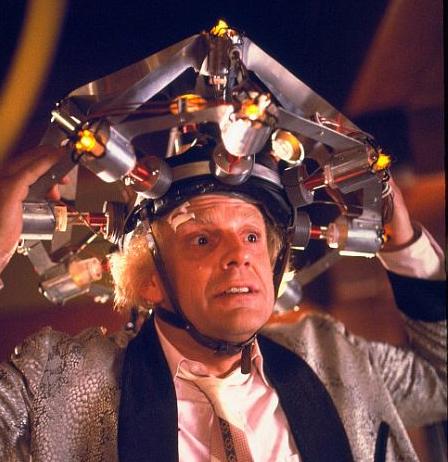 Researchers at MIT have developed an algorithm whereby paralyzed individuals can control prosthetic devices with their brains.
Researchers at the Massachusetts Institute of Technology said Wednesday that they've developed an algorithm for a neural prosthetic aid that can link an individual's brain activity to the person's intentions; and then translate that intention into movement.
Of course, other scientists have already done that, and built prototypes for neural brain-to-machine devices that can work for animals or humans. But each team has taken a different approach to the problem, such as developing algorithms for measuring activity in a specific brain region, or measuring them through EEGs vs. optical imaging.
MIT said that it has developed a unified algorithm that can work within the parameters of these different approaches. Lakshminarayan "Ram" Srinivasan, lead author of a paper on the subject, said MIT's new graphical models are applicable no matter what measurement technique is used.
via CNET News Blog
Wednesday, September 05, 2007
Speech-to-text using your cellphone
 Read/Write Web has posted a review of Jott, a mobile phone service that allows users speech-to-text functions such as dictating email messages. They have just released a service called “Jott Links” (and an API) that allows users to interact with websites like Zillow and Twitter using voice commands and speech recognition.
On the one hand this seems like a no-brainer, the perfect application of this technology. I spent a summer during college working for Speech Technology Magazine, and back then speech recognition software was mainly marketed for people with motor disabilities and those who liked to dictate their texts. With the proliferation of cell phones, it seems like this deployment of the technology should be a perfect fit for most people’s lifestyles. However, the limitations of the technology make me wonder how it will work. I could be hopelessly out of the loop here, but the speech recognition programs that I was familiar with back then depended on creating profiles of individual users, slowly learning how to decode the user’s speech through a trial-and-error process that required a lot of feedback in the form of corrections. Will Jott’s service do this, or has speech recognition evolved beyond this problem? If not, it could be a serious drawback. If a user wanted to post a message to a public service like Twitter, he or she will certainly want to make sure that message doesn’t contain any embarrassing malapropisms. It will be interesting to see if this feature catches on. There have been some significant developments in interface design lately, most notably the huge response that Apple has received for the iPhone and the iPod Touch, which was just released today. Perhaps they will coexist, and we will get used to an everyware-esque situation where our interactions with computing devices will fit much more naturally in our everyday actions.
Subscribe to:
Posts (Atom)