Update: This post is a partial review of Stuart Kauffman’s At Home in the Universe: The Search for Laws of Self-Organization and Complexity In At Home in the Universe Kauffman cites the Cambrian explosion—the appearance of an abundance of new life forms during the Cambrian period—as an example of a phenomenon that is difficult to explain using only the theory of natural selection. Natural selection suggests that gradual changes over time slowly accrue, allowing for the development of fitter organisms. This idea, however, is difficult to map onto the relatively rapid appearance of many different body plans during that period. A more selection-friendly period, Kauffman notes, is the rebound from the Permian extinction, when “96 percent of all species disappeared” (13). After the Permian the divergence in body plans, or phyla, basically ended. While there were “many new families, a few new orders, [and] one new class” that appeared at that time, there were no new phyla.
Kauffman refers to the Cambrian explosion as a top-down event—the rapid appearance of many wildly divergent kinds of organisms—while he calls the rebound from the Permian extinction—where there were many changes in the makeup of different organisms, but no new body plans—a bottom-up event (13). This movement from top-down to bottom-up events is typical, according to Kauffman, and is also seen in technological innovations, where an initial period of discovery is followed by an explosion of variations that later settle down into a few distinct, usually optimum, plans. The “branchings of life” that this particular view exhibits follows what Kauffman feels to be a lawful pattern—”dramatic at first, then dwindling to twiddling with details later”, what he calls a “complexity catastrophe” (14, 194). This catastrophe explains how “the more complex an organism, the more difficult it is to make and accumulate useful drastic changes through natural selection”, for “As the number of genes increases, long-jump adaptations becomes less and less fruitful” (194-95).
This process of organization comes from the tendency of “complex chemical systems” to become autocatalytic, that is exhibit a “self-maintaining and self-reproducing metabolism”, and it allows the process of ontogeny, where at division cells differentiate for different purposes (47, 50). In the first case, Kauffman demonstrates with Boolean networks how autocatalysis occurs naturally in chemical systems. The image on the right shows “a Boolean network with two inputs per node” where “colors represent the state of a node” as being on or off. Using a sparsely-connected network like this to model simple chemical reactions, Kauffman shows that “when the number of different kinds of molecules in a chemical soup passes a certain threshold, a self-sustaining network of reactions”, or autocatalysis, “will suddenly appear” (47). Kauffman argues that his behavior on the part of these chemical systems is completely expected, and therefore not mysterious, as many attempts to explain it imply. Kauffman’s Boolean networks show that “when a large enough number of reactions are catalyzed in a chemical reaction of system, a vast web of catalyzed reactions will suddenly crystallize”, a property that is completely expected (50).
These complex behaviors also explain ontogeny. The tendency of complex chemical systems to organize themselves into auto-catalytic systems leads to those systems settling into a few attractors (see Order for Free for a discussion of attractors in biological systems), a result that allows the cells to differentiate but only in limited ways. As cells branch out to become particular kinds of cells in the organism, their tendency to stay in the basin of the attractor keeps them from becoming disordered, yet allows them to continue to propagate themselves. Order, then, from both the top-down and the bottom-up, is “vast and generative” and “arises naturally” out of common chemical interactions (25).
Saturday, July 29, 2006
Top-Down


Order for free

Update: This post is a partial review of Stuart Kauffman’s At Home in the Universe: The Search for Laws of Self-Organization and Complexity
In At Home in the Universe: The Search for Laws of Self-Organization and Complexity (1995) Stuart Kauffman argues that traditional notions of how order arises are at best incomplete. Traditionally, it is assumed that Darwinian forces—“Random variation, selection-sifting”—were responsible for all the order we see in the universe (8). However, Kauffman demonstrates that random variation alone isn’t enough to explain the origin of order. By themselves, variation and selection are susceptible to two problems which counteract their organizing properties: if it proceeds towards an evolutionary dead end it can become “trapped” there and, even when it doesn’t run into this problem it is prone to “error catastrophes” (184). Kauffman derives this information from statistical models called fitness landscapes that map all the possible ways a particular environment can evolve. When the landscape is too rough the environment becomes “trapped or frozen into local regions” preventing further development. This problem is not solved by finding solutions with less peaks and troughs, for “on smooth landscapes” selection “suffers the error catastrophe and melts off peaks,” a process which would leave the genotype “less fit” (184-85). When an error catastrophe occurs, “the useful genetic information built up in the population is lost as the population diffuses away from the peak” (184); that is, whatever fitness the population may have demonstrated would be lost because the mechanism of selection is not capable of surveying a fitness landscape to find the best possible niches for the organism. This leads to Kauffman’s realization that “there appears to be a limit on the complexity of a genome that can be assembled by mutation and natural selection”, and, in turn, that there is not just a “singular source” of order in the universe—natural selection—but rather there must be another source as well, one that limits selection into useful areas of fitness (185, 71).
Kauffman calls this other source of order “self-organization”, and he argues that because of it, “vast veins of spontaneous order lie at hand” (8). Self-organization is a product of “extremely complex webs of interacting elements [that] are sparsely coupled” (84). When enough of these interacting elements are brought together and their ability to communicate is limited—Kauffman has shown that one optimum number is two connections each—they can organize themselves into regular patterns. These patterns are analogous to the attractors in complex mathematical systems, and systems that exhibit the behavior of strange attractors provide the complex qualities that Kauffman describes.
Additionally, Kauffman notes that these attractors often occur on the border between stable and chaotic behavior or “poised between order and chaos” (26). It is during the phase transition between the stable and the unstable that systems display organized behavior, what Kauffman calls “order for free” (106). This order is what makes natural selection possible, for it limits the action of complex systems—which often display more states than could be cycled through in the life of the universe—from all possible states to a few attractors, making ordered behavior not improbable but expected.
Tuesday, July 18, 2006
Complexity and AI
As these two recent articles—“AI Reaches the Golden Years” and “Brainy Robots Start Stepping Into Daily Life”—suggest, there is currently quite a bit of interest in the development of artificial intelligence. How to implement true machine intelligence, though, is still an open question.
The Wired article points out a problem AI has had since its inception: how to deal with ‘common sense.’ Even though computers like Deep Blue rock at chess, because of the complexity involved in modeling this kind of fuzzy knowledge, programming machines to do what are considered to be normal, everyday tasks is extremely daunting.

Deep Blue: “Bring it on”
In his 1994 book Complexification: Explaining a Paradoxical World Through a Science of Surprise, John L. Casti points out this difficulty with what he calls “top-down” AI models; that is, models that attempt to program in all the environmental factors that will affect the AI. This is the method that has a hard time with mundane tasks. Another, more profitable, method appears to be modeling systems from the “bottom-up,” that is, mimicking the process of the brain and allowing complex behavior to originate from those interactions.
This method, too, has its difficulties. Casti notes, and plieb has pointed out, that there is good reason to believe that to actually produce brain-like activity, a device “must also share the size, connective structure and initial configuration of the brain” (160). Though such a thing may be possible, Gödel has suggested that if it were to evolve, it would be too complex for us to understand, much as our own brains’ functions remain a mystery to us (Casti 167).

Gödel’s solution is supported by attempts at creating A-life via cellular automata (CA) like Conway’s Game of Life (an example of a “glider gun” CA from the Game of Life is pictured above_. Following Steen Rasmussen’s rules for what A-life must look like:
Postulate 1: A universal Turing machine can simulate any physical process.
Postulate 2: Life is a physical process.
Postulate 3: There are criteria by which we can distinguish between living and nonliving systems.
Postulate 4: An artificial organism must perceive a reality R*, which for it is just as real as the “real” reality R is for us.
Postulate 5: The realities R* and R have the same ontological status.
Postulate 6: We can learn about the fundamental properties of our reality R by studying the details of different R*s. (Casti 168-69)
A Game of Life board that could execute such a CA would be roughly 3 square kilometers in size (Casti 228).
These results to not mean that artificial life is out of the question. Casti suggests that the correct response to Gödel’s statement would not be to build AI, but to “grow” it using a bottom-up approach. This would allow for simple processes to form an aggregate—the final form of which, as noted above, would be too complex for us to completely understand—that would exhibit life-like behavior. This system would exhibit the properties noted by Stuart Kauffman in cellular interactions; that the “unimaginably complicated network of interactions” occurring in the cell don’t “lead to utter chaos, but rather results in the cell organizing itself into stable patterns of activity appropriate for its particular function in the organism” (Casti 267). Taking advantage of this spontaneous order is what the NYT article calls “cognitive computing” and falls under the heading of complexity. If such life is ever achieved, perhaps it will be Gödel’s standard—that we can’t understand it—that will validate it as being “alive,” rather than any other arbitrary list of behaviors.
Thursday, July 13, 2006
Notes on chaos
This post is a pretty random group of reactions to the ideas of chaos theory presented in James Gleick’s Chaos: Making a New Science (1987).
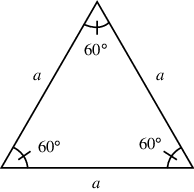
According to previous understandings of nature, “Simple systems behave in simple ways. . . . Complex behavior implies complex causes. . . . Different systems behave differently” (303). However, chaos theory argues that “Simple systems give rise to complex behavior. Complex systems give rise to simple behavior. And most important, the laws of complexity hold universally, caring not at all for the details of a system’s constituent atoms” (304). This theory suggests that commonly held assumptions about the behavior of the world are flawed. Natural systems do not exhibit simple, linear behavior. They do, however, exhibit patterns, but these patterns are often fractal, that is, they exhibit constant change and transformation at all scales and cannot be boiled down to simple geometric shapes. An example would be the contrast between a triangle, which only gives information at one scale, and a fractal image, which exhibits more information no matter what scale you look at.
“Libchaber believed that biological systems used their nonlinearity as a defense against noise. The transfer of energy by proteins, the wave motion of the heart's electricity, the nervous system—all these kept their versatility in a noisy world.” (194).
This is an interesting observation, since most communication deals at some level with the problem of overcoming noise, that is, barriers that prevent a clear understanding of the message. This phenomenon presents itself in nature as well as in language. Proposing non-linearity, the ability of seemingly chaotic systems to generate order, as a means of overcoming noise deserves more attention in studies of communication.
“the spontaneous emergence of self-organization ought to be part of physics” (252).
And everything else, I would say. The question of order pops up in a lot of scientific literature; attempting to find the answer to it is one of the things that attracts me to chaos and complexity theory. Most analytic effort is spent trying to explain the nature of order, but only recently has the origin of order taken the forefront in scientific questioning.
Wednesday, July 12, 2006
Metaphor and reality
Update: This post is a partial review of Kenneth Boulding’s Ecodynamics and James Gleick’s Chaos: Making a New Science
Lately I’ve been thinking a lot about the metaphors that Kenneth Boulding uses to describe the natural world in his Ecodynamics (1978). One such metaphor is evident in his statement that knowledge, or know-how, is embedded in the structure of natural objects. The way in which Boulding expresses this idea is that “in a certain sense, helium ‘knows how’ to have two electrons and hydrogen knows only how to have one” (14). This is a case where ‘structure’ has the ‘ability to “instruct”’ (13). One benefit of this particular way of looking at knowledge is that it limits what is determined about a subject to what can be known. A fact of an atom of helium is that it is an atom of helium, and that fact can be stated in terms of know-how. (Boulding uses this method to show how unhelpful the idea of the survival of the fittest is, for it really is just a statement about the survival of the survivors.) This metaphor is particularly powerful because it allows for our understanding of communication to explain natural phenomena like the replication of DNA. Know-how is communicated from the existing structure through other materials that lend themselves to communicating that structure as well. By accepting this metaphor, statements about language, the realization that “communication . . . becomes a process of complex mutuality and feedback among numbers of individuals that leads to the development of organizations, institutions, and other social structures which affect” the outside world (16). The spread of know-how through communication—the “multiplication of information structures” (101)—leads to complex behavior and organization, in persons as well as in nature. This phenomenon, communication through the propagation of order and know-how, can be seen in other natural structures. In Chaos: Making a New Science (1987), James Gleick identifies several of these phenomena like entrainment or modelocking, an example of which being when several pendulums, connected by a medium like a wooden stand that can communicate relevant information like rhythms, all swing at the same rate (293). Similarly, in the phenomena of turbulence, “each particle does not move independently”; in their interdependent interaction, the motion of each “depends very much on the motion of its neighbors” (124). I don’t think that it is much of a stretch to say that know-how is propagated through the constraints of strange attractors (the image to the left is of the Lorenz attractor) and similar phenomena. Chaotic phenomena behaves in a particular way because that is what it knows how to do.
Supposing we can accept this metaphor for behavior in nature, that it is a kind of communication where what is being communicated is knowledge, then it seems like it would be completely reasonable to use the language of rhetoric to describe natural behavior. The sensitive interdependence of the parts of a system, recognized 1) by Boulding in animal development where “the history of a cell in an embryo depends on its position relative to others rather than its past history, because its position determines the messages”—or information—“that it gets” (107), and 2) by the physicist Doyne Farmer, who, in describing mathematical equations notes “the evolution of [a variable] must be influenced by whatever other variables it’s interacting with,” for “their values must somehow be contained in the history of that” variable (266) suggests a rhetorical way of looking at nature. As Boulding acknowledges, everything depends on everything else, a point that rhetoricians have been making about the persuasive situation since the discipline was formed. This connection opens up the exciting possibility of rhetorical analysis of natural systems, where the tools of monitoring persuasion in language could be used to track the movement of know-how through nature.
Thursday, July 06, 2006
Complex Systems, hypnotism, magic
Update: This post is a review of Kenneth Boulding’s Ecodynamics: A New Theory of Societal Evolution
Bateson’s idea that communication is a replication of structure from one person to the next is also found elsewhere. In Ecodynamics (1978), Kenneth Boulding argues that the power of human communication comes from the ability of our brains—an ability for which he uses the metaphor ‘know-how’—to replicate structure across other brains (128). Boulding finds this tendency in structures like DNA, the structure of which attracts ‘a similar structure from its material environment’ and those new entities are able ‘form themselves, as it were, into a mirror image of the original molecule’ (101). Similarly, communication works by structures in one person’s ‘head’ ‘replicating’ themselves in the head of another. Or, to avoid the complications involved in going inside heads, it is the propagation of the know-how through the various structures for which it is coded.
This explanation of communication provides a partial understanding of hypnosis. In effect, hypnosis works through the physiological repression of the various means of suppressing this propagation of the code. Bateson describes this process in a circus animal, which he feels ‘abrogate[s] the use of certain higher levels’ of thinking; he argues that it is also the means of hypnotism (369). If the higher levels of intelligence are circumvented, either through the conscious will or through suggestive or physiological means, then there is no interference to prevent the code from replicating.
This realization leads to a biological explanation for effective communication. First, the code must be able to be received without interference. Second, it must have what Boulding calls the sufficient ‘material’ means to propagate (101). In the replication of DNA, this would mean the correct molecules and nutrients; In human communication, it would be effective channels by which the code could spread. Third, the code must be correctly encoded for the material in which it wishes to move. Both Bateson and Boulding suggest that magic represents an ineffective communication of this kind. If a person can be persuaded to do something by words or actions, the practitioner of magic argues, so can nature. However, nature is not designed so as to be able to receive communicative codes and is therefore not influenced by the majority of them (typically words or ritual behavior—changing the code so that it can be received by natural bodies, however, such as fertilizing a plant or seeding a cloud, does result in effect code propagation from humans to nature).
The similarities that are seen between code propagation across persons and in biological structures like DNA prompt both Bateson and Boulding to make a connection between minds and nature. Bateson points out that the basic unit of evolution—the interconnected system—is also the unit of the mind, which is not necessarily limited by the skull. Similarly, Boulding suggests that like environments, individual minds are connected through ‘writing, sculpture, painting, photography and recordings’ into a ‘single mind’ in that each individual mind ‘participates in the experience of other minds through the intermediary of communication’ (128). This fact leads to the interesting conception of the individual not as an individual, but as a part of a larger whole. Since most theories of communication are based on the first model, appropriating the second should have interesting effects on communication theory.