I’ve created a trailer for my spring 2008 course, “Literature and Mathematics”; it is embedded below. The plan for the course is to investigate how mathematics and mathematicians are depicted in literature, particularly the ways in which these two themes are associated with delusions and insanity. I tried to emphasize these connections in the video (and make the course seem a little more interesting to prospective students).
CNET News is reporting on a Pew Internet & American Life Project study called “Teens and Social Media,” which found that teenage girls tend to blog more than teenage boys (35% and 20%, respectively) and that teenage boys post more videos online than girls (19% of boys have posted a video online compared to 10% for girls).
However, for me the most interesting news is that teens take greater measures to protect their privacy online than adults do.
But how safe are teens being in protecting their personal information and images? More safe than adults, apparently. About 66 percent of teens with a social network profile restrict access in some way and 77 percent of teens who upload photos restrict access some of the time, while only 58 percent of adults who post photos restrict access.
For video, a smaller percentage (54 percent) of teens restrict access, about the same as adults.
Mr. Rice will often write a letter on his typewriter, scan it into his computer, and then send the image as an e-mail “Some people are tickled by it,” he “Some people are absolutely annoyed.”
Apparently, Rice prefers the tactile feedback of typewriter keys to the “mushy” response of a computer keyboard.
Second, novelist Richard Powers, who won the National Book Award for The Echo Maker, also dislikes typing, and in an interview on NPR’s Fresh Airexplains why he likes to compose his novels using speech-recognition software instead.
The Powers interview was particularly interesting to me because I spent a summer working as an intern at Speech Technology magazine in the summer of 2000. At that time, I think it would have been extremely cumbersome to dictate a long text using speech-recognition, given the limitations of the technology back then—it demanded a lot of computing power, required users to speak using unnatural cadences so the software could distinguish between words, and users had to spend a lot of time training the software to recognize their accents and speech patterns before it was very accurate. Apparently the technology has improved quite a bit, or, at least, Powers has found a way around its limitations.
One question I had about Powers’s process that wasn’t answered in the interview was: how does he revise? Does he use the software, or does he revert to a keyboard for this part of the writing process?
Motorists may be in for a surprise if they spot flashing red lights in their rearview mirrors in this Sacramento suburb during the holiday season. Police are stopping law-abiding motorists and rewarding their good driving with $5 Starbucks gift cards.
A traffic officer came up with the idea to "promote the holiday spirit and enhance goodwill between the traffic unit and the motoring public," police Sgt. Tim Curran said.
infrared sensors to look for the red-eye phenomenon familiar from family snapshots. The device looks like a small webcam and can detect a passing glance from over 30 feet away. This year, the company will roll out its Eyeanalytics software, letting advertisers monitor how many people are looking at each of their ads, and for how long.
As the internet-advertising model becomes more dominant, this kind of technology is going to become more in demand.
Path Intelligence is a U.K. based company that monitors foot traffic in a rather ingenious way, through customers’ cell phones. Periodically our cell phones ping the nearby cell towers basically saying “Here I am”. Path Intelligence has built receivers that detect these signals and triangulate the owner’s location with accuracy of up to a meter.
Each ping also includes the cell’s unique identifier (think IP address). While these IDs help track the movement of the signal and it’s owner, they don’t reveal the identity of the user. Only your service provider knows that. This is a similar, but more precise method than Google Maps is using to detect your general location on your mobile phone by cell tower.
While it is encouraging that it the unique identifiers are not available to the service, I don’t think this anonymity will be worth much. Unless there are laws in place that state otherwise, just like ISPs turn over IP addresses whenever they are asked for, these identifiers will be available whenever law-enforcement demands them.
According to the New York Times, Google is developing a web-publishing platform that sounds a lot like Wikipedia.
The project, which is in an invitation-only beta stage, lets users create clean-looking Web pages with their photo and write entries on, for example, insomnia. Those entries are called "knols" for "unit of knowledge," Google said.
The key difference from Google’s offering and Wikipedia will be that individual authors will receive credit for their material.
Google asserts that the Web's development so far has neglected the importance of the bylined author.
"We believe that knowing who wrote what will significantly help users make better use of web content," wrote Udi Manber, vice president of engineering, on the official Google blog
Additionally, users won’t be able to edit each other’s entries.
Based on that last fact, I don’t see how this service is going to rival Wikipedia’s 7 million articles. At this point in the history of the web, I’m surprised that a company as savvy as Google would ignore the clear benefits of distributed publishing. At best, the service will probably get a few thousand decent articles on niche topics.
Although I believe Google has a point in noting the neglect of attribution for web content, I can’t see how they’re going to succeed when they depend on individual contributors to provide and edit all of their own content. I just don’t think that there is that much individual expertise out there that will be willing to put in the time to write quality articles for the service.
Cameron Reilly of The Podcast Network has created a new site, Twittories, for crowdsourced stories composed in Twitter (via TechCrunch).
My wife and I were putting our kids to bed and we were doing something we have done with them since they were about two years of age. One of us starts a new story by telling a few lines and then the next person picks up where they left off and so on. I thought “gee, this is like a Twitter conversation” and started to wonder what it would be like to have a bunch of folks on twitter collaborate on a short story—140 characters at a time.
Apparently, a similar phenomenon has already demonstrated that it has legs: in Japan, novels are currently written and consumed on cellphones.
In a related post on Read/Write Web, Alex Iskold responds to a post by Fred Wilson on microblogging (Wilson drew the graph above), expanding on Wilson’s claim that microblogging fits a niche in personal publishing not met by chat, social networking, or blogging. Iskold concludes his piece this way:
The personal publishing market evolved from cumbersome web sites to online diaries called blogs to social networks and more recently to microblogs. Each form of personal publishing is different and each has its niche and audience. While social networks have been the most wide spread, the content creation there feels different from publishing. Because traditional blogging platforms are powerful and still require technical know-how, microblogging has evolved as an intermediate form of self-publishing. Microblogging has a shot of spreading blogging further into the mainstream as well as swaying some professional bloggers to start personal blogs.
Although Iskold doesn’t mention micro-fiction like Twittories in his post, it will be interesting to see how this kind of writing fits into the microblogging niche.
In a recent article, Peter Drescher argues that stereo cellphone headsets will make possible interactive communication experiences on the go.
I’m looking at wireless stereo headsets, and thinking that as they become more comfortable, more useful, more powerful, more commonplace, and more stylish, there will be fewer and fewer reasons to ever take them off. Eventually, you’ll just stick them in your ears and forget about ‘em. They will become like acoustic contact lenses, or a heads-up display for your ears. They’ll let you access and control a virtual audio reality that streams in from wireless networks all around you and is mixed with voice data from your phone and from everybody’s phone. And although the ubiquitous audio network I’m describing does not yet exist, you can actually listen to what it might sound like today.
It’s completely analogous to being in a recording studio, isolated by big headphones, auditioning multiple tracks, and talking to the control room via live mic. I remember my first time in a real studio: I put on the cans and was astounded by the sense of space, the detailed audio field, and the sound of my own voice—in my head, through the mixing board. Now imagine that feeling as a mobile experience, but instead of talking to the engineer on the other side of the glass, you’re walking down Broadway, talking to someone on the other side of the world.
In response, Tim O’Reilly points out that stereo headsets will be the first components of mainstream wearable computing.
I’m sure that at first, when only a few people are living in the mobile “heads up” auditory network, they will be quite “annoying” in public spaces, but eventually, I imagine we'll figure out how to deal with that. There's a lot that's compelling in this vision. I've always imagined heads-up visual displays being one of the harbingers of the era of wearable computing, but Peter makes a pretty compelling case that it’s in audio that we’re going to see the first signs of ubiquitous wearable computing.
Jon Oltsik at the CNET News Blog posted a blog entry this week on the “god box,” a single device “packed with ridiculous amounts of functionality.”
Think of an all-in-one television, cable box, TiVo, and home entertainment speaker system and you get the idea. One “god box” always replaces numerous more pedestrian systems.
According to Oltsik, new developments in processors, hardware commodification, and software are going to make these god boxes a reality.
My problem with this idea, though, is that I’m not sure who would want this kind of functionality in a single box. One caveat: though he doesn’t come out and say this, I think Oltsik’s post might be directed at the business networking crowd. I can see why a business IT department might want to distribute god boxes as terminals. However, since he brought up the home entertainment example, I don’t see how a god box would be desirable in that context. I think consumers have made it clear that they don’t want certain kinds of hybrid devices: computers that connect to the television have never caught on, for example. Rather, what people want is ease of connectivity, a “god network,” if you will. They want to watch TV on their TVs and compute on their computers; but, when they are away from those devices, they want to access their music, documents, TiVo programs, or live TV on their MP3 players or phones.
I think it is far more likely that the technological innovations Oltsik describes are going to turn the phone into a god device. It won’t be one where the majority of users will choose to do all of their specialized tasks—that is, the phone is not going to replace computers, televisions, home stereos and the like. Rather, it will be one that can access the functionality of those other devices on the go.
(Of course, cellphones are replacing all of these devices in Japan, so I could be completely wrong about the above.)
The Chronicle of Higher Education published an article last week on the difficulties academics face when using Facebook. While the article contained some good, commonsense advice about how instructors should interact with their students on the site, it also revealed how little understanding most instructors have of social networking culture.
Nancy Baym worries more about students’ expectations of her. A few weeks ago, a young man she did not know tried to friend her, says Ms. Baym, an associate professor of communication studies at the University of Kansas. The same student e-mailed her the next day, asking to get into a class that had a waiting list. He must have thought, “If she’s my friend, then she’ll let me into the class,” she says.
Young, female faculty members already struggle to be seen as authority figures, says Ms. Baym. It was easy to imagine what might happen: “But how could you have given me a D? You’re my friend on Facebook!”
Now, lots of people use Facebook, for lots of different reasons; however, I think it is highly unlikely that the unknown student friended her in order to enact the social code that Baym suggests: “If she’s my friend, then she’ll let me into the class.” I would guess that it is much more likely that the student perceived the interaction as an introduction, analogous to the student introducing himself to Baym at her office.
In short, I think Baym is making the mistake of thinking that being someone’s “friend” on Facebook is equal to being his or her “friend” in some other social context. I would be surprised if the average Facebook user expected (or demanded) the same commitments from his or her online “friends” as from offline ones.
I remember an episode of Alvin and the Chipmunks from when I was a kid, where, for some reason, the ‘munks were involved in a baseball game. At a crucial plot moment, Simon was called up to bat, and the drama of the scene came from the fact that Simon wasn’t athletic (for those of you not familiar with the characters, Simon, on the far left, was the nerdy one). However, before Simon stepped up to the plate, he took a quick moment to work out the physics of the ball’s trajectory (I can’t remember the details, but if you want to optimize the distance of a projectile, you should launch it at a 45º angle; to go a specific distance—say, over the outfield wall of a baseball field—you just need to know how much force to put behind it) and he then promptly stepped up to the plate and knocked the ball out of the park.
Even though I couldn’t express why at the time, I knew that wasn’t right. Simon’s baseball heroics reminded me of those scenes in The Matrix where the characters have skills—karate, flying a helicopter—imported directly into their brains through the data ports in their heads, the implication being that the mere fact that they have received this information makes them able to physically perform specific tasks. However, know-what does not equal know-how.
I know there are examples where people have brought physical processes into coordination with abstract information; one example that comes immediately to mind is musicians with perfect pitch. With the right kind of training, a person can be taught to distinguish individual notes purely by sound or hit a ball with so many pounds of force or at a particular angle. However, the key word here is “training.” The knowledge wouldn’t be sufficient to the skill, for the skill could only be acquired through bodily training.
It seems far more likely that physical processes like hitting a baseball or kicking Agent Smith’s ass are dependent on embodiment; that is, the process is learned through the combination of the mental and physical systems of the body (see Varela, Thompson, and Rosch’s The Embodied Mind). For that reason, merely having information about something does not necessarily translate into having the skill—or know-how—to accomplish a task.
I started thinking about this recently because of Bionic Woman. On an episode from a few weeks ago, Jamie has to stop a whirling fan so Dr. Burke can practice his karate moves on terrorists. As she prepares to grab the spinning blades, we get a shot of her bionic vision, and there is a readout showing the fan’s rotation speed in m/s*s.
This struck me as another example of the Matrix Fallacy. Knowing how fast a fan is spinning doesn’t necessarily translate into knowing when to reach in and grab the blade.
I suppose you could argue that Sommers’ bionics have solved this problem for her by interfacing between her physical systems and abstract ideas like m/s*s. However, this kind of abstract processing has been the goal of AI since its inception, but has so far seemed impossible. At any rate, it would be more interesting if the show illustrated the bionic woman’s skill in ways that made more sense in light of embodiment.
In an article on new data-theft techniques, Yuval Ben-Itzhak argues that by setting up accounts in trusted Web 2.0 sites, hackers can avoid current security features that prevent spyware from uploading stolen personal information.
In Web 2.0 and beyond, a stealthy Trojan on your PC will no longer need to send its stolen data to a malicious host server in the Third World. Rather, the Trojan will upload data to a MySpace page or another “trusted” Web 2.0 site that will not be blacklisted by URL filtering or reputation-based solutions. Once the data is downloaded from these sites, it is deleted. In essence, hackers could turn these sites into “safe harbors” for storing their stolen data.
This is an interesting downside to the read/write web that I hadn’t heard anyone articulate before.


![Xuuk]s eye-tracking device](https://blogger.googleusercontent.com/img/b/R29vZ2xl/AVvXsEjE_mu3BScGRmf9XEKlpXELJUElQv25OXobvL_RTz6S4AFpHVJzZvAM_cPfix6KjurpQvp619tW8Nu78XrweB99U_u390rG8MKiAKfXuxlqaH0XK7hzZWveT5a3pau8S_ersGpE/s1600/eye_tracker.jpg) • Xuuk’s
• Xuuk’s 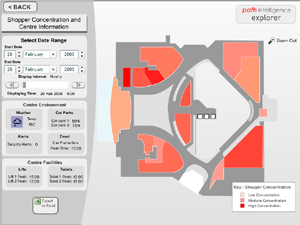 • Path Intelligence’s
 I remember an episode of
  Even though I couldn’t express why at the time, I knew that wasn’t right. Simon’s baseball heroics reminded me of those scenes in The Matrix where the characters have skills—karate, flying a helicopter—imported directly into their brains through the data ports in their heads, the implication being that the mere fact that they have received this information makes them able to physically perform specific tasks. However, know-what does not equal know-how.