Friday, June 27, 2008

Wordle as research tool

Lee Sherlock has posted some ideas for analyzing Wordle text clouds.

Wordle text cloud for Bell's An Introduction to Cybercultures

Wordle opens up some "new," and potentially surprising, combinations and juxtapositions of terms that can lead to new avenues for analysis. Out of this cloud, I might pull out "cyborg spaces" or "computer symbolic construction" or "political-economic transparency" or "Visible surveillance architectures" as potential (re)combinations. Some will be more useful than others, but this experiment might point to some of the gaps in how we define and employ these terms.

Plus, it looks like a submarine.

Tuesday, June 24, 2008

“The ambusher became the ambushed”

Congressman John Culberson of Twitter fame ambushes a TMZ paparazzi. Scroll to the 2:07 mark of this video to see the encounter.


via Robert Scoble

Employee of NBC partner (possibly) fired for leaking news of Russert’s death on Wikipedia

There are some conflicting reports here, but the current story is that an employee of NBC partner Internet Broadcasting Services (IBS) updated Russert’s Wikipedia page before the official announcement of his collapse, adding his date of death and changing verb forms to the past tense. When this was discovered, someone at the same company reverted the changes. The NYT has reported that the employee was subsequently fired, although this last point is in dispute.

via Silicon Alley Insider

Summary of Lessig political reform speech on CNET

Lawrence LessigCNET’s Caroline McCarthy has posted a summary of one of Lawrence Lessig’s speeches associated with his Change Congress initiative.

“Even though today the individuals [in Congress] are better than the individuals who populated our government in the past, the problem of this corruption is much worse,” Lessig explained. “And it’s much worse because government today is much more significant. It’s first more critical to core national problems...and second, it’s more pervasive. The government’s fingers are everywhere.”
...
But the other big difference between the 19th century’s politics and today’s is what’s making possible Lessig’s mission at Change Congress: Daniel Webster’s America didn't have Wikipedia, WordPress, or Twitter. (It would’ve been kind of cool, though: “Wig shopping with @henryclay, then out to eat. WTF is with these tea prices?”) The Web’s tools have made it possible for far more information to make it into the hands of ordinary citizens, and those citizens in turn can use the Web to band together and work toward democratic action.

The post made me think of George Lakoff’s new book The Political Mind. According to Amazon, the book seems to be a rhetorical look at politics over the last decade or so, focusing on the ways in which pure rationality has failed progressives. I bought a copy yesterday, and I’m excited about reading it.

The Tweetularity is near

Little more than a week-and-a-half after this post on the future of Twitter, the future seems to have arrived. At least that’s what Robert Scoble says.

Twitter has evolved from status updates into public conversation with colleagues, companies, and your target audience.

Scobleizer: Stream of Consciousness

via Steve Rubel

Friday, June 20, 2008

A perfectly ludicrous response to ludicrousity

In response to the Associated Press’s ridiculous claim that anyone who quotes more than 5 words of one of their articles should pay for the privilege, Michael Arrington has sent them a DMCA notice for quoting more than 5 words from one of his blog posts.

While on the one hand I think this is a perfectly appropriate move, illustrating the absurdity of the AP policy, I wonder if somehow it will provide encouragement to the wire service, you know, of the “if Arrington is doing it, then we made the right move” variety. I guess we’ll have to see how the situation develops.

Link: The A.P. Has Violated My Copyright, And I Demand Justice

Thursday, June 19, 2008

Kevin Kelly on a “dead media”

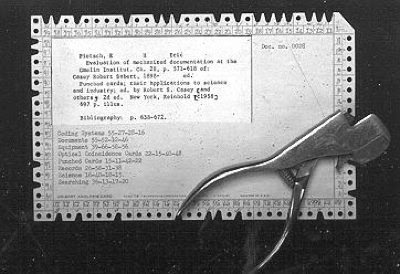
card and hole-punch for edge-notched card filing system
Kevin Kelly has posted a fascinating article on the history of edge-notched cards. Before computers, I would have loved these things.

Tuesday, June 17, 2008

Wordle maps of my notes

I uploaded my notes for my current project into Wordle. Here are the notes from last semester:


And here are my current notes:


via Information Aesthetics

Thursday, June 12, 2008

Google and paper

On the heels of my post from a few days ago about the sketchpaper iPhone, this TechCrunch article on the evolution of Gmail’s interface shows that Google’s engineers have paper copies of the app’s UI pasted to their wall. So far, it seems that no technological innovations have surpassed paper for certain design tasks.

The future of Twitter

O’Reilly’s Ben Lorica says that it will be similar to the explosion of popularity in blogging.

When Microblogging Grows Up

Wednesday, June 11, 2008

Political appropriation: “Barack Hussein Napoleon Pol Pot Obama”

I’m in the middle of reading Jeff Rice’s The Rhetoric of Cool, and the section on appropriation made me think of this bit from last Wednesday’s Daily Show:


Writing about appropriation, Rice notes that while it often associated with advertising and commerce—such as the appropriation of youth culture by corporations to sell products—it can also be used

to learn the methods of persuasion conducive to new media (61).

I think Stewart and Co.’s riff on Obama’s “Hussein problem” is an example of this persuasive appropriation. The method is typical of The Daily Show: by taking the right-wing smear campaign aimed at Obama’s middle name to a ridiculous extreme, they show that it is merely ridiculous.

In other news, I’m excited that Stewart and Colbert are on Hulu now. It retrospect, it is easy to see why Hulu beat Jotspot. The service that makes linking and embedding easy is much more likely to catch on online.

Are you gone? May I join?

page 1 of Beatnik questionaire

Last night I ran across this “Beatnik Questionnaire” on the Ransom Center’s website. According to the site, it was “Adapted from the "Beatnik Questionnaire" sent from Gerard Malanga to Daisy Aldan, 1960.” The questions are fairly humorous, and seem pretty tongue-in-cheek. Most are apparently designed to show if the respondent can understand beat slang. The whole thing goes on for four pages, including essay questions (“Write an original Beatnik poem in 20 lines”) and more outlandish requests (“Compose 8 bars for Bongo drums”).

Monday, June 09, 2008

FriendFeed for live-blogging

WWDC attendee MG Siegler is saying that FriendFeed is the best way to blog live events.

I created the room last night and started posting some questions such as, “What do you think is the more important feature, 3G or GPS?” The room filled up rather quickly with both FriendFeed power users and bystanders alike. By the time Steve Jobs’ keynote kicked off today at 10 am, we had over 500 members in the room interacting with us. (Remember, that is just members who joined to interact with us. It’s like a giant chat room minus all the nonsense usually associated with chat room.)

And that is really the key here, the interaction. Unlike if we were to do a constantly updated live blog post where users would have to do the usual routine of posting comments, which is both relatively slow and are unlikely to get answered, FriendFeed allowed us to have a conversation with those who weren’t at the event.

I haven’t had a chance to use FF’s new rooms feature, but it seems like it is a great addition to the service. However, I wonder how long the service can be “like a giant chat room minus all the nonsense.” Presumably, the nonsense is kept at a minimum by the fact that the number of obnoxious users is low. As the number goes up (it should correlate with the site becoming more popular), the nonsense level is likely to rise. This will lead us right back to a blog-type situation, where it is necessary to moderate comments, thus keeping them from appearing in a timely manner.

via Steve Rubel

Sketchpaper iPhone

I don’t know if this is useful, but it is neat. I really enjoy seeing how people integrate paper into their digital activities.

sketchpaper iphone

the folks at Labs.Boulevart were kind enough to put together sketchpaper versions of the iPhone. It's a free download (in PDF or Photoshop flavors) of just a bunch of images of the iPhone, left completely blank (sometimes with the MobileSafari and/or carrier bar on there) for designers of all kinds to sketch on and imagine with as they will.

Very cool idea, and the number of different setups and implementations they've thought of is impressive—just the kind of thing to get the iPhone creative development juices flowing.

Sunday, June 08, 2008

Computers and education

Slate’s Ray Fisman has an article outlining some of the fallacies associated with the equation computers + kids = learning. The impetus for the article is a study of a Romanian program to supplement the purchase of personal computers for families with children. I haven’t had a chance to read the article, but I think Fisman makes some points that stand up independently of it.