Oh, boo-hoo. Having millions of people love something you created so much that they want to create something of their own in order to share that love with others—that must feel awful.
Friday, February 29, 2008


Thursday, February 28, 2008
MS World Wide Telescope launch at TED
This video, featuring Roy Gould of the Harvard Center for Astrophysics and Curtis Wong of Microsoft, introduces Microsoft’s new program, World Wide Telescope, a kind of Google Earth for the Galaxy.
Gould argues that the software will allow users to 1) experience the universe as a kind of “magic carpet” ride that lets you go where you want to go, 2) “tour the universe with astronomers as your guides” using the built-in tours, or 3) create your own tours through the universe, which can be shared with others. Gould claims that this last point is the most exciting because it will allow a “community of storytellers evolve and emerge” around the images of our galaxy.
The software will be available as a free download this spring from worldwidetelescope.org
Data graphics based on song lyrics
Information aesthetics has posted some links to graphs and other information graphics based on songs. Here are my two favorites:

Nader gets pwned
From Figaro:
The rumpled crusader maintains that that his campaign shouldn’t affect the outcome at all. But it’ll jack up his ego like a pimped-out Corvair.
Figaro interviewed Nader in 2000, months before he denied Democrats a win in the crucial Florida balloting. When Figaro asked if someone put a gun to his head and told him to vote for either Gore or Bush, which he would choose, Nader answered without hesitation: “Bush.” Al Gore, he said, had “totally betrayed” his environmental stand. “If you want the parties to diverge from one another,” Nader continued, “have Bush win.”
Mission accomplished.
Wesch on collaborative research
 Michael Wesch at Digital Ethnography has posted a description of a collaborative research environment developed by one of his classes.
During the first month of the semester the Digital Ethnography class of 2008 has been hard at work trying to leverage various online tools to improve our collaborative research efforts. We have managed to pull together a number of free tools into a single research platform that I think is going to work out very nicely.
Wesch then goes on to describe how he and and his students have cobbled together a shared, online environment for recording their research notes and other materials using Netvibes, Zoho, wikis, and other tools. It seems like a great setup, particularly for this application: researching digital environments.
I am curious, however, to see how similar tools will be used for other kinds of research, particularly research of non-digital subjects. Any good tool needs to be 1) suited to the task and 2) suited to the user. My suspicion is that while Wesch’s online research environment works great for digital research—for example, Wesch describes a tool for displaying online video next to a research form, the latter of which can be filled out while the video is playing—I wonder if its usefulness for other research tasks—say, traditional library research—will be somewhat limited. Some users simply don’t like to read a book in front of the computer, for instance. (Although, people’s habits are rapidly changing, so it may turn out that I’m completely wrong about this.) In short, this is a great setup for online research, but its efficacy for other kinds of research will depend on individual user’s habits and what it is they want to study.
Wednesday, February 27, 2008

Chronicle.com on Twitter
Jason Jones at The Salt Box has posted a link to the Chronicle of Higher Education’s recent story on academic uses of Twitter (sequestered behind paywall, or free for a limited time).
Most of the article repeats basic claims about new communication technologies—a lot of Tweets are mundane, some are profound, be careful what you post. There is some good stuff on one of the most interesting uses of Twitter: a broadcast-messaging system for emergency announcements. Overall, it’s a good summary of how the technology is being used by some academics, along with the benefits and possible drawbacks of integrating microblogging into academic or pedagogical pursuits.
Multi-touch
 Apple has updated their MacBook Pro line of laptops, adding the multi-touch feature introduced with the MacBook Air. This article by Tom Krazit speculates on the future of this technology and how Apple and Microsoft will be deploying it in the future. As usual, Apple seems to be pushing the development of this technology—Krazit reports that other laptop vendors will be pushing similar technology soon. Hopefully this doesn’t mean there will be a bevy of competing standards and interfaces for users to deal with.
Transfer options
Abilene Christian University is handing out iPhones or iPod touch-es (?) to new students. As the article points out, this is a great move for universities—the devices are cheaper than laptops—and for students—who wants to carry a laptop everywhere, anyway (unless it’s a MacBook Air, of course)?
Managing online identity
Lifehacker has posted a feature on why you should manage your online reputation and how to do it. According to the article
Anyone can create a web page that describes you inaccurately or criticizes your performance at a company. Web sites have emerged to trash bad dates and insult company representatives—and those pages are not what you want potential dates or employers to find when they Google you. If making a good name for yourself online is a priority, it's time to take a proactive approach to getting your name out there the way you want.
It’s a great introduction to a topic that most people probably aren’t even aware of, much less in control of.
Tuesday, February 19, 2008
Graphing zombies
Last night I was trying to explain to my girlfriend why this t-shirt is totally awesome and hilarious, a task which eventually led to the Wikipedia entry for “Uncanny valley,” a term used to describe the human feeling of repulsion for humanoid robots that are not completely lifelike. To my great surprise and pleasure, I found that the entry was accompanied by this awesomely ridiculous graph: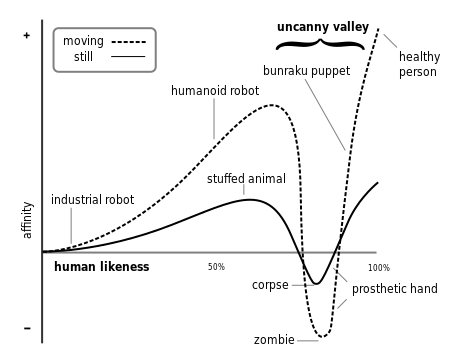
You see, if you plot the human likeness of things that move ( _ _ _ ) and things that don’t move ( ___ ) against their degree of familiarity, it is plain that zombies occupy a more central position in the uncanny valley than do stuffed animals or bunraku puppets.
My only question is: How do we classify Jeffy using this scheme?
The dashed line indicates he’s ambulatory, and he is vaguely humanoid (he clearly has a human likeness); yet for some reason he still creeps me out.

Lessig ‘08
Lawrence Lessig has launched a website, Lessig08.org, featuring a video where he explains
the launch of two exploratory projects—first, a Change Congress movement, and second, my own decision whether to run for Congress in the California 12th.
via O’Reilly Radar
Monday, February 18, 2008
Fair and balanced
I like Cory Doctorow, but I love the title to his Boing Boing post on the reaction of Guantánamo’s management to the new Harold and Kumar movie:
Gitmo’s torturers decry negative portrayal of gulag in new Harold and Kumar comedy
The next installment in the Harold and Kumar franchise is called “Harold and Kumar Escape From Guantánamo Bay,” in which our lovable heroes end up in America’s gulag when someone overhears them talking about “bongs” and thinks they’re talking about “bombs.” The criminals who run the prison camp on behalf of the US government evince distress at this because they hope that the world will see the secret prison as a clean, well-run, efficient gaol (filled with people so dangerous that they can’t be convicted of any crime).
Saturday, February 16, 2008
More on Lessig for Congress
From TechCrunch
With the death of California Representative Tom Lantos on Monday, a special election will be held in April to fill his seat in Congress. Will Stanford Law professor Lawrence Lessig run? Already on Facebook, a “Draft Lessig for Congress” group has formed (with 554 members as of this posting). Lessig, who has long been a champion of Free Culture as a lecturer, intellectual property lawyer, and CEO of Creative Commons, has recently turned his attention to corruption. (He has a wiki about corruption here). In fact, his last lecture on Free Culture, which he has been giving for ten years, was on January 31.

People are making lots of hay out of the fact that Lessig registered the domain name “Change-Congress.com,” but to me this just sounds like preparation for his new work on government corruption.
Although I’m a fan of Lessig’s and I think he would make a great legislator, I wonder whether he would be interested in this post. It seems to me that he could have more influence on government as an outsider, and he wouldn’t feel the constant pressure to campaign that would hound him if he were an elected official.
Friday, February 15, 2008
Teaching digital literacy
AcademHacK David Parry has an editorial in Science Progress responding to educational institutions banning Wikipedia. He argues that outlawing sites like Wikipedia robs students of much-needed training in using new media.
we do a fundamental disservice to our students if we continue to propagate old methods of knowledge creation and archivization without also teaching them how these structures are changing, and, more importantly, how they will relate to knowledge creation and dissemination in a fundamentally different way.
I particularly enjoyed Parry’s description of the encyclopedia:
No longer is an encyclopedia a static collection of facts and figures (although some of its features might be relatively so); it is an organic entity. To educational and policy institutions which, for a substantial portion of history, have maintained control over static codex centered archives—think not only academic libraries, but national ones as well—the shift to an organic structure which they no longer control or solely influence represents a crisis indeed. But to train students in old literacy seems to me to be fundamentally the wrong approach. As Howard Rheingold suggests in Smart Mobs, in the future individuals will be divided between “those who know how to use new media to band together [and] those who don’t.”
While Parry might be giving “educational and policy institutions” short shrift [subscription needed], I think he is exactly right about encyclopedias. In fact, when I talk with people about Wikipedia, I like to go further and argue that the encyclopedia—the “static collection of facts and figures” Parry describes, which, I would argue, is held by many to be an objective repository of unassailable knowledge—has never existed, and never could exist.
Despite the protestations to the contrary of some encyclopedia creators, the encyclopedia has never been a repository of objective knowledge but is and always has been a situated cultural artifact that can only be reliably counted on to record what counts as knowledge at a particular moment in history. Subsequently, encyclopedias are as prone to error and crimes of omission as any other text, and criticizing Wikipedia for not being a “proper” encyclopedia—again, a thing that has never existed—is a bit like criticizing a horse for not being a unicorn.
That’s why I think Parry’s description of Wikipedia as an “organic” body of knowledge is a much more workable, accurate definition of the encyclopedia than the received definition. While Wikipedia does represent a shift in what counts as knowledge and how that knowledge is to be archived and accessed, the fact of the matter is that the encyclopedia has always been a shifting, living thing; with Wikipedia the technology has caught up to the reality.
There is a downside to this new approach to the encyclopedia, though. Wikipedia is not merely a living, organic body of knowledge, but it is also a democratized body of knowledge. As Parry notes, Wikipedia doesn’t merely provide the settled opinion on a subject, but it also provides “debate and discourse around” that subject. In the case of heavily debated topics like global warming and evolution, that preference for debate has given non-scientific voices a prominence they probably don’t deserve, making it seem that debate exists where it perhaps does not. However, I believe this democratization—where debate is open to the public—is preferable to the old hierarchy, where the authority of publishing is the final arbiter of which knowledge is approved and which is not, for it lends prominence to the rhetorical positioning of knowledge, making rhetorical tools much more important for those who would have their ideas accepted in the commons.
This problem only lends more support to Parry’s argument: that students need to be familiar with this new approach to knowledge ushered in by new media, and scientists and other knowledge workers “will need to posses a new type of collaborative literacy”—one steeped in rhetoric and the techniques for gaining adherence to ideas—in order to disseminate their findings.
Wednesday, February 13, 2008
Facebook simplifies account deletion
But there is still no master “delete” button.
On Monday, Facebook modified its help pages to tell people that if they wanted to remove their accounts entirely, they can direct the company by e-mail to have it done. But on Tuesday, representatives of Facebook stopped short of saying the company would introduce a one-step delete account option.
I called this on Sunday. While Facebook has had a number of high-profile customer-service problems, they typically attempt to resolve them quickly.
Interestingly, while coverage of this issue has (correctly) focused on privacy,—customers want to control their data—there has been little focus on why Facebook has made this process difficult. It’s not because Facebook wants to spy on their users. Rather, I would argue that there is no delete button because customer data is the only thing that Facebook “owns.” Its entire business model is based on users voluntarily providing the site with their preferences and social networks. While Facebook’s director for user experience and design Katie Geminder claims that the company keeps user information so users can reactivate their accounts—
Ms. Geminder said that Facebook’s policies were a reflection of the fact that many people came back to Facebook after they stopped using the site for a time. “On any given day, the number of users reactivating their accounts is roughly half of the number of users deactivating their accounts,” she said.
—she doesn’t mention that they also need this information. It doesn’t make any sense (from a strictly business perspective) for the company to allow users to easily delete the valuable information they have provided the site.
One obvious solution to this problem—users want to own their data and decide what happens to it, while Facebook wants to have access to that data, at least in situations where users decide to return to the site—is for Facebook to let users take their data with them when they leave the site, instead of deactivating or deleting accounts. That way, users will feel that their data is protected, and, if they decide to return to the site, the valuable data will have been archived. It’s a win-win.
Tuesday, February 12, 2008
Google’s Marks on the social graph
Google’s Kevin Marks made this presentation at the LIFT conference on the “Social Cloud.” I haven’t had a chance to watch it all yet, but when I do, I’ll post some thoughts.
via ReadWriteWeb
Related: Tim Berners Lee on “the Graph”
Sunday, February 10, 2008
Deleting a Facebook account
According to the New York Times, it’s hard to delete your Facebook account.
While the Web site offers users the option to deactivate their accounts, Facebook servers keep copies of the information in those accounts indefinitely. Indeed, many users who have contacted Facebook to request that their accounts be deleted have not succeeded in erasing their records from the network.
Apparently, to successfully delete your account, you have to delete all the information it contains:
Facebook’s Web site does not inform departing users that they must delete information from their account in order to close it fully — meaning that they may unwittingly leave anything from e-mail addresses to credit card numbers sitting on Facebook servers.
Only people who contact Facebook’s customer service department are informed that they must painstakingly delete, line by line, all of the profile information, “wall” messages and group memberships they may have created within Facebook.
Based on what I read here, it seems like the basic conflict is between Web 2.0 principles—you want to keep customer data, because “data is the next Intel inside”—and customer usability. This is a site-wide problem for Facebook; their global settings aren’t comprehensive enough, and too many privacy settings have to be set individually for each app. However, I think Facebook has a good track record of responding to problems noticed by readers, so I wouldn’t be shocked if this issue was dealt with soon.
Friday, February 08, 2008
Lessig on supporting Obama: Character and integrity
Jim Brown at the Blogora recently posted a link to this video by Lawrence Lessig on why he supports Obama over Clinton. One of the main reasons Lessig prefers Obama is that he conducts himself with more character and integrity than Clinton. That point reminded me of Paul Krugman’s repeated comments on Bush’s lack of integrity during his 2000 campaign
Do you remember all the up-close-and-personals about George W. Bush, and what a likeable guy he was? Well, reporters would have had a much better fix on who he was and how he would govern if they had ignored all that, and focused on the raw dishonesty and irresponsibility of his policy proposals.
Lessig makes a pretty convincing argument Obama is running a more credible campaign than Clinton.
Wednesday, February 06, 2008
Review: Tapscott and Williams, Wikinomics: How Mass Collaboration Changes Everything (2006)

Synopsis
According to Tapscott and Williams, there are four principles of Wikinomics: openness, peering, sharing, and acting globally. By openness, they mean that businesses must become less proprietary, arguing that in the current economic climate, businesses can’t afford to hoard all of their valuable information. Rather, they need to make it open so as to increase their ability to research and discover new products, as well as to make use of new standards for sharing information. For example, few businesses have the ability to throughly research and analyze all of the data available to them; by making some of that data open, Tapscott and Williams argue that businesses can harness the benefits of having an increased number of eyeballs looking for problems and new opportunities that would otherwise languish in forgotten data.
With peering the authors argue that the hierarchical relationships that dominate most large-scale enterprises should be broken down and replaced by more flexible peer-production methods, like those used in open source projects such as the Linux operating system. Tapscott and Williams argue that by taking advantage of peer-production methods, businesses can leverage the self-organizing forces to make better decisions and create better products without expending more capital.
While the idea of sharing that Tapscott and Williams advocate is likely to be as counter-intuitive as their other Wikinomics ideas, it is less radical and less dependent on new technologies than peering. The authors argue that, instead of keeping intellectual property like patents proprietary, business should open up their IP holdings for licensing by outside entities. By doing so, businesses can have access to more revenue through licensing fees, and also create new product lines by collaborative relationships with other businesses. Like peer-production, sharing allows for new relationships to form that would likely be ignored by businesses focusing on core products and competencies. These new relationships would benefit from self-organizing, emergent effects that lead to new opportunities without demanding heavy investment in research and development or new personnel.
Finally, the increased reach of the web, coupled with faster connections and greater computing horsepower, have enabled what were previously global interactions—a conversation with a supplier in another country, for example—to feel local and instantaneous. For this reason, the authors argue that businesses need to act globally, taking advantage of their ability to coordinate with suppliers and employees across the world.
Open cultures
I found that the most compelling part of the text was its focus on the culture of open enterprises. Tapscott and Williams continually emphasize that to take advantage of the changing economic and technological landscape, businesses must be ready to change their internal cultures and adopt the cultural practices of the community—Linux, Wikipedia—they wish to emulate. According to them, open, peer-production networks have distinct cultures that have to not only be respected by business, but also be leveraged if they wish to make use of the benefits of those networks. In my research of Wikipedia and other peer-produced systems, I’ve been interested in the ways that peer-produced texts depend on the creation of a community of value; that is, the creation of a culture that provides content creators with a return on their investment of time in the project. I think Tapscott and Williams correctly identify this feature of open source projects and argue for its acceptance by those who would use these methods of production in their business.
If I had to make a complaint about the book, I think it would be that the authors take for granted the benefits that “Wikinomics” will bring to business. While it is somewhat normal for those advocating new technologies to gush about their benefits and turn a blind eye to their potential drawbacks, I did get a little tired of the repeated insistence that these new economic forces were going to completely transform business practices for the better. I agree that there are tremendous benefits to the ideas that Tapscott and Williams outline here, I would have enjoyed a more critical approach to their benefits and drawbacks as well. However, that one quibble didn’t ruin the book for me, and I think it is still a valuable introduction to the theory of open source production.
Subscribe to:
Posts (Atom)