Thursday, July 31, 2008

Let the Swiftboating begin!

From The New York Times:

Mr. McCain’s campaign is now under the leadership of members of President Bush’s re-election campaign, including Steve Schmidt, the czar of the Bush war room that relentlessly painted his opponent, Senator John Kerry of Massachusetts, as effete, elite, and equivocal through a daily blitz of sound bites and Web videos that were carefully coordinated with Mr. Bush’s television advertisements.

Here’s the video in question (via the Huffington Post):

"What we decided to do is find the top three international celebrities in the world, and I would say from our indications, Britney and Paris came in second and third," said campaign manager Rick Davis. "Will people think of this as negative advertising? Look, it is the most entertaining thing I have seen on TV in a while." He went on: "It is not our campaign that is trying to make him into an international celebrity. It's his campaign... I don't know Paris Hilton and Britney Spears but they are international celebrities, so, you know, apples to apples."

I would like to think this is going to backfire on the McCain campaign. (Just for the ineptness alone: could the inset shots of Hilton and Spears be any more ham-handed?) Perhaps this time the press won’t let the Republicans control them quite so blatantly.

Friday, July 25, 2008

Very cool augmented reality game demo on Vimeo.


Here’s the description of the game:

levelHead uses a hand-held solid-plastic cube as its only interface. On-screen it appears each face of the cube contains a little room, each of which are logically connected by doors.
In one of these rooms is a character. By tilting the cube the player directs this character from room to room in an effort to find the exit.

Some doors lead nowhere and will send the character back to the room they started in, a trick designed to challenge the player's spatial memory. Which doors belong to which rooms?

There are three cubes (levels) in total, each of which are connected by a single door. Players have the goal of moving the character from room to room, cube to cube in an attempt to find the final exit door of all three cubes. If this door is found the character will appear to leave the cube, walk across the table surface and vanish.. The game then begins again.

link via Make Blog

Wikipedia vs. Knol: Jimbo Wales edition

Jimmy Jimbo WalesRachel Marsden has posted a Knol on Jimmy Wales (photo at right), the co-founder of Wikipedia. As you may recall, the point of Knol is to provide a more accurate source of information, one that is not subject to the inaccuracies and personal rancor that some attribute to Wikipedia.

Here’s how Marsden, who previously was in a relationship with Wales, describes him in her Knol, titled “Jimmy Wales (Jimbo Wales)”:

Jimmy (Jimbo) Wales is the Co-Founder of the online libel board, Wikipedia: The website any loser can use to smear people who are more successful than them.

One might note that this description, while of debatable accuracy, is unarguably suffused with personal rancor. The rest of the article reads:

Unlike Wikipedia, this article will be updated with accurate, relevant, encyclopedic information. The subject can send me information about himself and I'll decide what's worthy of posting here, after debating it vigorously with myself. Certain co-authors who know the subject well will also be invited to contribute. But again, we'll keep this collaboration closed to "respect human dignity". As "God Queen" and "Spiritual Leader" for "Jimmy Wales", that will be my guiding principle.

Based on my reading, I wonder if Marsden will be able to uphold the promise of that first sentence.

The point of all this is that Knol is already falling prey to the Wikipedia problem it puports to correct. As Elinor Mills puts it:

It will be interesting to see how the Marsden-Wales fracas plays out on Knol. Google's response didn't give me any confidence that the system won't be widely abused. And it's likely that people who disagree with my knol will create one of their own with contradictory conclusions.

Thursday, July 24, 2008

“Who watches The Young Watchmen? YOU WILL!”

As someone who is getting wrapped up in all the Watchmen hype, I enjoyed this spoof by Brian Hughes of Again with the Comics:

Watchteens logo

Young Watchmen returns viewers to the world of the critically acclaimed DC Comics and Hugo award-winning graphic novel by Alan Moore and illustrated by Dave Gibbons…100 years later! When not attending classes at Veidt High, OWLBOY, KID RORSCHACH, SPECTRA, JOHNNY COMEDY, and MANHA-TEEN have banded together to protect the world that their ancestors saved! With the help of OZZY, the World’s Smartest Lynx, they learn to work together, cruise the cyber-malls, and hang out at the nearest Gunga Diner…that is, when they’re not battling Alien Invaders, Supervillains, or the evil hordes of M.O.L.O.C.H.! These young descendants of the original Watchmen have vowed to carry on their legacy and protect the world at all costs. Who watches The Young Watchmen? YOU WILL!

Wednesday, July 23, 2008

Google launches Wikipedia competitor Knol

I’m skeptical about Knol. While the idea of adding experts to the Wikipedia model sounds great, as with Citizendium it’s not clear if the site will gather the critical mass necessary to make the whole thing worthwhile. But if anyone can take down Wikipedia, I think it would be Google.

Like Wikipedia, Knol (unlike many other Google products, officially it's just "Knol," not "Google Knol") allows anyone to create a page about any topic. By default, new pages are set to use "moderated collaboration," which means anyone can contribute to them but additions only go live after the page's main author or authors allow the contributions to be added.

It's a nice idea. Potentially, it helps solve issues like vandalism yet allows for a broad group of people to contribute. It also is a chief argument in favor of why Google even needs to introduce a tool like Knol, that it is providing what will likely be a robust authoring tool with a unique set of features.

link

Tuesday, July 22, 2008

Rhetoric and society

portrait of Peter Ramus, rhetorical bad guyLately I’ve been thinking about the problems that rhetoricians have sharing our knowledge with others outside the field. Ever since Ramus limited the scope of rhetoric to style and delivery, rhetoricians have been losing the public battle over the relevance of what we do. This situation was not much improved when rhetoric attached itself to freshman composition, the indentured servitude of academic disciplines. Like freshman comp, rhetoric is seen as somewhat remedial, unnecessary for people who are already good communicators.

As a student of rhetoric, I find this view of rhetorical studies to be somewhat limiting, in that it ignores the substantial contributions that rhetoricians have made to our understanding of reading and writing practices, as well as of argument and other forms of communication.

Which brings me to this Lifehacker post which I saw over the weekend.

Job interview master Vj Vijai describes how make the best impression at a technical interview using people skills (versus technical skills). His talk, which happened at O'Reilly's awesome Ignite event, is informative, funny, and short. Vijai also has a web site outlining the principles.

I thought that description sounded catchy, so I clicked on the link and here’s what I saw:

NLP or Neuro-Linguistic Programming is a rogue branch of pschylogy that is based on the premise that language and communication can be used to influence people.

What he is teaching isn’t hacking or psychology but rhetoric! This conclusion is reinforced by reading the comments on the Lifehacker post. They read like a greatest hits of criticism of rhetoric: if this is so great, why doesn’t it work all the time? Isn’t this manipulation?

I am continually shocked that rhetoricians have allowed our subject matter to be hijacked in this way, but I‘m not sure how we can reenter the conversation without seeming out of touch—quick, which term is more appealing, ‘pathos’ or ‘Jedi mind tricks’?—or worse, whiny.

Anyway, here’s the video of Vijai’s talk:

xkcd on literary criticism

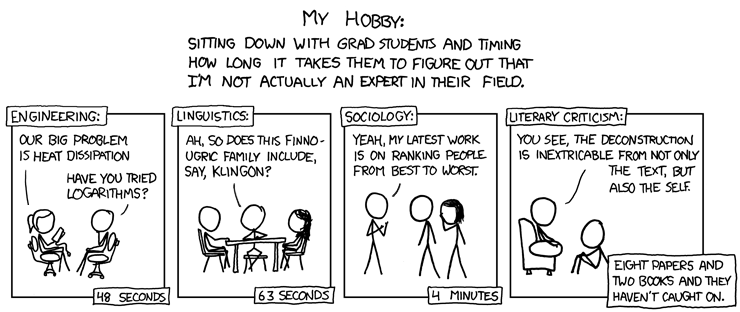
So, here’s Friday’s xkcd, called “Impostor”:

xkcd on literary criticism

The basic joke is that lit crit and sociology aren’t hard sciences, and the farther any field is from the hard sciences, the easier it is for any idiot to pretend to be an expert in said field. In addition to this explicit content, the subtext for the joke is that even the “experts” in these fields aren’t experts in the way that an engineer is an expert.

Now, I don’t think that literary criticism is a hard science. However, I think the joke becomes a bit of a cheap shot when this subtext is investigated. The joke is about knowledge communities in that the protagonist is seeing how long it takes for each group to realize that he doesn’t share the knowledge of their subfield.

While we can all debate the merits of literary criticism,—I myself have some doubts about its usefulness—what xkcd’s author Randall Munroe is charging here is that the knowledge community created by literary criticism has no boundaries, but is rather merely a set of cleverly-arranged buzzwords like “deconstruction” which are used to dazzle and distract instead of increasing knowledge. At this level, the joke also seems to be a sly reference to the hoax Alan Sokal perpetrated on Social Text, the cultural studies journal where he managed to get a “phony” article published.

The reason I think this joke gets its laughs cheap is that it is targeted at grad students. Of course English grad students can be easily bamboozled—they are also new initiates to the lit crit knowledge community, and like the protagonist of this strip they are unable to tell what fits into the field and what doesn’t. It would be slightly more difficult for him to pull this stunt with an English professor. This perspective flips the joke somewhat in that if Engineering grad students can be completely initiated into their knowledge community so quickly, it must not be as complex as the knowledge community of literary criticism.

Friday, July 18, 2008

Tom Brokaw on new media

From this New Yorker profile of Keith Olbermann.

Brokaw calls this moment in the news media “the second big bang.” “We are creating a new universe, and it has all kinds of new laws and science and physics coming into play as well, in this information world,” he told me. “And you’ve got planets out there colliding with each other, new life forms taking shape; others have drifted too close to the sun, and they’ve burned up. And we don’t know how it’s all going to settle down. And it has, now and forevermore, a radiant effect.”

Thursday, July 17, 2008

English Wikipedia possibly adding site-wide editing?

The system would be based on a model being used on the German Wikipedia. From the New York Times’ Bits Blog:

The German site, which is particularly vexed by vandalism, uses the system to delay changes from appearing until someone in authority (a designated checker) has verified that the changes are not vandalism. Once a checker has signed off on the changes, they will appear on the site to any visitor; before a checker has signed off, the last, checker-approved version is what most visitors will see. (There are complicated exceptions, of course. When a “checker” makes a change, it appears immediately. And registered users, who make up less than 5 percent of Wikipedia users, will also see “unchecked” versions.)

Google’s market for Android

Google's AndroidClay Spinuzzi has posted an interesting analysis of Google’s positioning of Android, its mobile phone software. Spinuzzi argues that Google is targeting the product between the business (Blackberry) and consumer (iPhone) markets, looking instead to tap the small enterprise market.

Google is going to use Android to facilitate latent connections among emergent organizations and organizational forms, such as federations and coworking. It’s not focusing on a tightly controlled consumer experience, like the iPhone, or a tightly controlled corporate infrastructure, like the Blackberry or WinMobile devices. It’s going to focus on the many small businesses that have to do B2B collaboration, the professionals who have to be increasingly mobile while facilitating face-to-face meetings, the loose collaboration that is increasingly characterizing knowledge work.

The intriguing question here is: How long will Google be satisfied with this market before it begins to expand to the others?

DIY Google images

I enjoyed this:

Google images paper craft

Finding classes via social media

Here’s an interesting post on how a prospective student found one of my classes.

Social Tech on Campus in Practice

Thursday, July 10, 2008

Prep hoops star skips college, heads to Europe for a year

So, the NCAA is broken, right? We can all agree on that now, can’t we?

Brandon Jennings, hoops experts say, was the most talented high-school basketball player in the country last year. Don't expect to see Jennings in the NCAA Tournament next March, though. On Tuesday, the player's lawyer announced that he'll prepare for the NBA by playing in Europe next year.

If Jennings sticks with his decision and makes his way to the top of the 2009 NBA draft, other high-school stars may follow his lead. The father of one of the most heralded players in the high-school class of 2009, Lance Stephenson, told the New York Times that the family was aware of Jennings' decision: "We're looking at it and we're interested just like anyone else." Let's conduct a thought experiment: If America's best prep players all decided to play abroad, what would happen to the global basketball ecosystem?

The Great Basketball Exodus

The cries of the Naderesque

One day I hope to be able to unpack an idea like Larry Lessig. In this blog post, he explains his very level-headed reaction to Obama’s vote on the FISA bill.

It was a political mistake for the reasons I’ve already explained: it was self-Swiftboating. This shift is fuel for the inevitable "flip-flop" campaign already being launched by the Right. Their need to fuel this campaign is all the more urgent because of the extraordinary "flip-flops" of their own candidate. So anyone with half a wit about this campaign should have recognized that this shift would be kryptonite for the Barack "is different" Obama image. Just exactly the sort of gift an apparently doomed campaign (McCain) needs.

But again, to say it was a political mistake is not to say it was a mistake of governance. To do right (from the perspective of governance) is often to do wrong (from the perspective of politics). (JFK won a Pulitzer for his book about precisely this point.) So at most, critics like myself can say of this decision that it was bad politics, even if it might well have been good governance. Bad politics because it would be used to suggest Obama is a man of no principle, when Obama is, in my view, a man of principle, and when it is so critical to the campaign to keep that image front and center.

And finally

please, fellow liberals, or leftists, or progressives, get off your high horse(s). More on this with the next post but: it is not "compromising" to recognize that we are part of a democracy. We on the left may be right. We may be the position to which the country eventually gets. But we have not yet earned the status of a majority. And to start this chant of "principled rejection" of Obama because he is not as pure as we is, in a word, idiotic (read: Naderesque).

The immunity hysteria

Tuesday, July 08, 2008

Restricting Congressional Tweets?

Texas Congressman John Culberson has posted a link to a letter by Michael E. Capuano, the Chair of the Congressional Franking Comission and Congressman from Massachusetts, which Culberson claims will require prior approval for posts to non-governmental websites resulting in

No more live [Qik] videos - no more live Tweets from the House floor or anywhere in the Capitol - no more www communication w/o prior approval

Here is a link to the document. I’ve posted the relevant recommendations below:

House recommendations on use of outside web sites
I like Culberson, and I wish more of our governmental officials would embrace web communication technologies in the way that he has. However, I wonder if he is overreacting to this document. Unless he is referring to some other as yet unpublished communication, it’s difficult to find the rules he is complaining about in the actual document. The document itself refers explicitly to online video, advocating the establishment of a dedicated congressional channel on a web video site (YouTube, I presume, although the letter isn’t specific) for House members to publish video content. The first and third recommendations would require the videos to be compatible with existing House communication rules, while the second encourages (it doesn’t require) the channel to not show ads, and the fourth suggests the establishment of some kind of rules for posting on non-governmental sites. Those rules all seem sane to me, but here’s Culberson’s take:

Dem "Supreme Soviet" leadership of House would have to approve every Twitter before I could post it!!

I just don’t see that in this document (although more documents might be forthcoming). And, frankly, I find the name-calling and the implication that there is some sort of conspiracy of silence being put in place by the “Dems” a little hard to take from a member of Dick Cheney’s party.

Update: Culberson says:

Look at page two - note each Twitter etc must meet "existing content rules and regulations" that means prior approval/rewrite

However, Culberson notes that this rule applies to almost anything he says, acknowledging that his phone conversations should be censored. Of course, they aren’t censored, making it difficult for me to see how this new ruling about video posts will lead to censored Twitter streams.

Stephen King on Writing

Some helpful writing advice from Stephen King:


Via Freelance Writing Jobs